How to Read Your Electrical Panel (And Why It Matters for EV Charging)
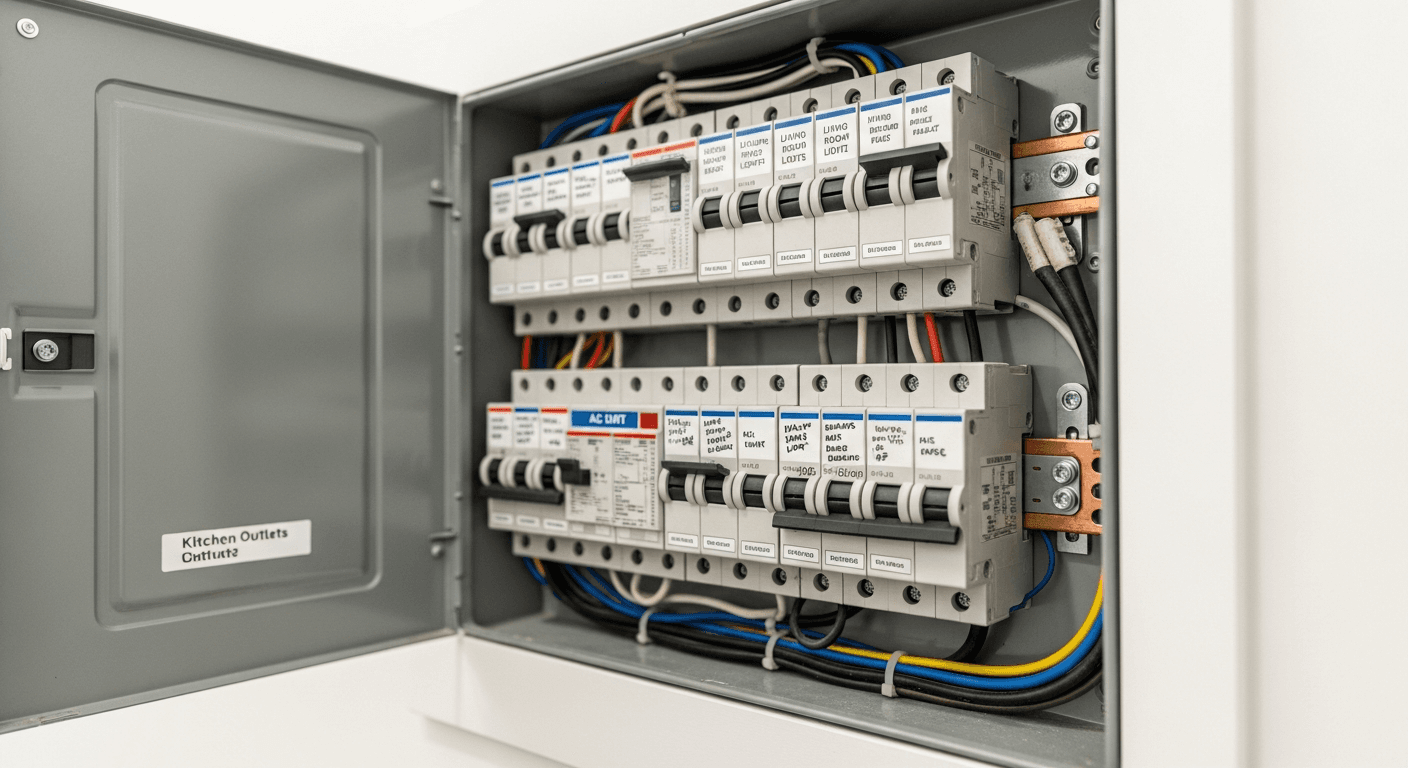
Your Electrical Panel Is More Important Than You Think
Most homeowners never open their electrical panel. It's that gray metal box in the garage or basement with a bunch of switches that you only touch when the power goes out. But understanding your panel is surprisingly useful — especially if you're thinking about adding an EV charger, upgrading your HVAC, or doing any kind of renovation.
This guide will walk you through everything in that box: what the switches mean, how to read the labels, and how to figure out whether your panel can handle what you want to plug into it.
What Is an Electrical Panel?
Your electrical panel (also called a breaker box, load center, or distribution panel) is the central hub where electricity enters your home and gets distributed to individual circuits. Power comes in from the utility through your meter, enters the panel through the main breaker, and then branches out through individual circuit breakers to different parts of your house.
Think of it like a water main splitting into individual pipes for each sink, shower, and toilet. The panel is the splitter.
The Main Breaker
At the top (or sometimes bottom) of your panel, there's one big breaker — usually labeled 100A, 150A, or 200A. This is your main breaker, and the number tells you your panel's total capacity in amps.
- 100-amp panel: Common in homes built before 1970. Adequate for basic needs but tight if you're adding major loads. These are increasingly considered undersized for modern homes.
- 150-amp panel: A middle ground, found in some 1980s–1990s homes.
- 200-amp panel: The modern standard. Required by code in most new construction since the early 2000s. Handles most residential needs including EV charging, heat pumps, and modern kitchens.
- 320-amp or 400-amp: Large homes or homes with all-electric systems (no gas). Two 200A panels or a 400A service is becoming more common as homes electrify.
Your main breaker rating tells you the maximum current your entire home can draw at once. Every circuit below it shares that total capacity.
Branch Breakers: Single Pole vs. Double Pole
Below the main breaker, you'll see rows of smaller breakers. These are branch circuit breakers, and they come in two types:
Single-Pole Breakers (120V)
These are narrow — they take up one slot in the panel. They're rated at 15A or 20A and supply 120 volts. This is what powers most of your home:
- 15-amp circuits: General lighting and receptacles in bedrooms, living rooms
- 20-amp circuits: Kitchen countertop outlets, bathroom outlets, laundry room, garage outlets
Every outlet you plug a lamp, phone charger, or coffee maker into is on a 120V single-pole circuit.
Double-Pole Breakers (240V)
These are wider — they take up two slots (or are physically two handles tied together). They supply 240 volts and are rated anywhere from 20A to 60A+. These power your heavy hitters:
- 30-amp double-pole: Electric dryer, water heater
- 40-amp double-pole: Electric range/oven, large heat pump
- 50-amp double-pole: EV charger (Level 2), large range
- 60-amp double-pole: Sub-panel feed, central AC compressor
If you're adding an EV charger, this is the type of breaker you'll need — more on that below.
How to Read the Panel Label
Open your panel door (the outer cover, not the inner dead front) and you should see a label or directory — either printed on the door or taped inside. This maps each breaker number to what it controls.
A typical panel label looks like this:
- 1: Kitchen outlets
- 2: Master bedroom
- 3/5: Electric range (double-pole, using slots 3 and 5)
- 4: Living room
- 6: Bathroom
- 7/9: Dryer (double-pole)
- 8: Garage
Breakers are numbered top to bottom, alternating left and right. Odd numbers are typically on the left, even on the right. Double-pole breakers span two consecutive odd or even numbers on the same side.
Reality check: In most homes, this label is either illegible, outdated, or completely wrong. The previous owner (or a lazy electrician) labeled things incorrectly, or new circuits were added without updating the directory. If your labels are a mess, take an afternoon to map them: flip each breaker off one at a time and note what loses power. It's tedious but worth doing once.
Understanding Your Panel's Load
Here's where it gets practical. Your panel has a maximum capacity (let's say 200 amps), and your existing circuits are using some of that capacity. The question is: how much room do you have left?
The Simple Method
Add up the amp ratings of all your breakers. But here's the thing — that total will almost certainly exceed your panel's rating, and that's normal. A 200-amp panel might have breakers totaling 300+ amps because not everything runs at the same time.
This is called the demand factor. The National Electrical Code (NEC) recognizes that a home never uses 100% of its theoretical load simultaneously. The NEC provides specific calculation methods (Article 220) for determining actual demand.
The NEC Load Calculation (Simplified)
A proper load calculation (what an electrician does before adding circuits) considers:
- General lighting and receptacles: 3 VA per square foot of living space
- Small appliance circuits: 1,500 VA each (minimum 2 required)
- Laundry circuit: 1,500 VA
- Fixed appliances: Nameplate rating of each (water heater, dishwasher, disposal, etc.)
- HVAC: Largest motor load (AC or heat — you use the larger one, not both, since they don't run simultaneously)
- Dryer: 5,000 VA minimum or nameplate, whichever is larger
- Range: Uses demand factors from NEC Table 220.55
After tallying everything up, demand factors are applied to reduce the total (the first 10,000 VA at 100%, the rest at 40% for general loads). The final number divided by 240 volts gives you your calculated load in amps.
If this sounds complex — it is. This is what electricians get paid to figure out. But the simplified version: if your existing calculated load is under 80% of your panel's rating, you probably have room for additions. Above that, you're getting into upgrade territory.
Why This Matters for EV Charging
This is where electrical panels become a hot topic (literally). A Level 2 EV charger — the kind that fully charges your car overnight — typically needs:
- 40-amp circuit: For a 32-amp charger (most common residential, charges at ~7.7 kW, adds ~25 miles of range per hour)
- 50-amp circuit: For a 40-amp charger (faster, charges at ~9.6 kW, adds ~30 miles of range per hour)
- 60-amp circuit: For a 48-amp charger (maximum residential speed, charges at ~11.5 kW, adds ~37 miles of range per hour)
Under the NEC, a continuous load (one that runs for 3+ hours — which EV charging is) must be sized at 125% of the actual draw. So a 40-amp charger needs a 50-amp breaker and corresponding wire gauge (6 AWG copper).
Adding a 50-amp circuit for an EV charger on a 200-amp panel is usually feasible — if you're not already near capacity. On a 100-amp panel, it's often the tipping point that requires a panel or service upgrade.
What an EV Charger Installation Actually Costs
- Charger unit: $400–$700 for a quality Level 2 hardwired unit (ChargePoint, Grizzl-E, Emporia, Wallbox)
- Basic installation (panel in garage, short run): $500–$1,200
- Longer run (panel in basement, charger in detached garage): $1,500–$3,000
- Panel upgrade (100A to 200A): $2,000–$5,000 (this is the big one)
The federal 30C tax credit that previously covered 30% of EV charger installation costs (up to $1,000 residential) expired at the end of 2025. Today, the full install cost is on you — but many utilities and automakers still offer rebates of $200–$700 for Level 2 chargers, especially if you enroll in a time-of-use rate plan.
If you're trying to figure out whether your panel can handle an EV charger — or what the total install will cost — Electrum Home's EV Load Calculator can help you assess your panel's capacity and estimate the project cost in a few minutes.
NEC 2023/2026 Changes You Should Know About
The National Electrical Code updates every three years, and recent changes affect homeowners:
EV-Ready Requirements
NEC 2023 (Section 210.17) requires new construction to include at least one dedicated 40-amp, 240V circuit for EV charging in attached garages. Many states adopting NEC 2023 or 2026 are enforcing this in new builds. If you're buying new construction, this should already be in place.
AFCI and GFCI Expansion
Arc-Fault Circuit Interrupters (AFCI) are now required on nearly all 15- and 20-amp branch circuits in habitable areas. Ground-Fault Circuit Interrupters (GFCI) requirements have expanded to include all 240V receptacles in garages, basements, and outdoors. These specialized breakers cost more ($30–$50 each vs. $5–$10 for standard breakers) but prevent fires and electrocution.
Load Management / Energy Management Systems
NEC 2023 introduced provisions for Energy Management Systems (EMS) that can dynamically manage loads. This is a game-changer for homes with smaller panels — instead of upgrading to a bigger panel, you install a smart load management device (like a Span panel, Emporia Vue, or DCC-9 from Wallbox) that automatically reduces non-critical loads when the EV charger is drawing power. This can save $2,000–$5,000 vs. a panel upgrade.
When You Need a Panel Upgrade
Here are the clear signs:
- Your panel is 100 amps or less and you want to add significant loads (EV charger, heat pump, hot tub, workshop)
- You're out of breaker spaces. No empty slots for new circuits. (Note: tandem/slim breakers can sometimes free up space, but not all panels accept them.)
- You have a Federal Pacific or Zinsco panel. These brands have documented safety issues — they were found to fail to trip during overloads, creating fire hazards. If you have one, replace it regardless of capacity needs.
- You have a fuse box. Technically functional, but insurance companies increasingly require breaker panels, and fuse boxes can't be expanded.
- Your load calculation exceeds 80% of panel capacity. This is the NEC's safety threshold for continuous loads.
- Breakers trip frequently. Occasional trips are normal (you plugged in too many things on one circuit). Frequent tripping on multiple circuits suggests you're maxing out the panel.
What a Panel Upgrade Costs
- 100A to 200A upgrade: $2,000–$5,000 (includes new panel, breakers, and meter base if required)
- 200A to 400A upgrade: $4,000–$8,000 (usually involves adding a second panel or upgrading the service entrance)
- Panel replacement (same amperage, new panel): $1,500–$3,000
The utility company may need to disconnect and reconnect your service, and your municipality will require permits and inspections. The whole process typically takes 1–2 days.
Smart Panels: The Future
Companies like Span and Leviton now make smart electrical panels that give you per-circuit monitoring and control from an app. You can see exactly how much energy each circuit uses in real time, set priorities for load management, and even prepare for solar or battery backup integration.
Smart panels cost $4,000–$7,000 installed — a premium over standard panels, but they're increasingly popular in homes going all-electric. If you're already doing a panel upgrade, it's worth considering.
Safety First: What NOT to Do
A few important warnings:
- Never remove the inner dead front cover (the metal panel behind the breaker switches) unless you're a qualified electrician. The bus bars behind it carry full line voltage and can kill you.
- Never use a breaker rated higher than the wire it protects. If a 15-amp breaker keeps tripping, the solution is NOT to replace it with a 20-amp breaker. The breaker protects the wire from overheating — oversizing it creates a fire hazard.
- Don't double-tap breakers (two wires under one breaker terminal) unless the breaker is specifically rated for it. This is a common code violation found in home inspections.
- If your panel feels warm, smells like burning, or you see scorch marks, call an electrician immediately. These are signs of loose connections or failing breakers — both fire risks.
Frequently Asked Questions
Can I add a breaker to my panel myself?
Technically, in most jurisdictions, homeowners are allowed to do their own electrical work (with a permit). But working inside a live panel is genuinely dangerous — the main bus bars are always energized even when the main breaker is off (they're upstream of it). Unless you have electrical experience and understand the risks, hire a licensed electrician. The cost ($150–$300 to add a circuit) is well worth the safety.
How do I know if I have a Federal Pacific or Zinsco panel?
Look at the panel label inside the door. Federal Pacific Electric (FPE) panels usually say "Stab-Lok" on the breakers. Zinsco (also sold as Sylvania or GTE Sylvania) panels have distinctive colored breaker handles (often pastel blue, green, or red). If you have either brand, get a quote for replacement — these panels have a well-documented history of breaker failure. Home inspectors flag them, and some insurance companies won't insure homes with them.
What's the difference between a panel upgrade and a service upgrade?
A panel upgrade replaces the breaker box inside your home. A service upgrade includes the panel plus the wiring from the utility meter to the panel (the service entrance conductors), and possibly the meter base itself. If you're going from 100A to 200A, you almost always need a full service upgrade because the existing wires can't safely carry 200 amps. The utility company coordinates the meter side; your electrician handles everything else.
Do I need a sub-panel or a main panel upgrade?
A sub-panel is a secondary panel fed from your main panel. It's useful when you need more breaker spaces but your main panel has sufficient amperage. Common uses: detached garages, workshops, additions, or finished basements. A sub-panel costs $500–$2,000 installed. However, a sub-panel doesn't increase your total available amperage — it just redistributes it. If your main panel is maxed on capacity (not just spaces), you need a main panel or service upgrade.
How does solar affect my panel?
Solar panels connect to your electrical panel through a dedicated breaker (typically 20–40 amps). The NEC has a "120% rule" that limits the total amperage feeding into a panel. For a 200-amp panel, the combined main breaker plus solar breaker can't exceed 240 amps (200 x 1.2). This means a 200-amp panel can accept up to a 40-amp solar breaker. If you need more solar capacity, you may need a panel upgrade, a line-side tap, or a load management system. Your solar installer will calculate this during the design phase.
Will an EV charger raise my electric bill a lot?
The average EV driven 12,000 miles/year uses about 3,600 kWh of electricity annually. At the national average of $0.16/kWh, that's roughly $48/month — far less than the $150–$200/month you'd spend on gasoline for a comparable ICE vehicle. Charging at off-peak rates (if your utility offers time-of-use pricing) can reduce this further. Some utilities offer dedicated EV charging rates as low as $0.05–$0.08/kWh during overnight hours.
Ready to move forward?
See what your project actually costs.
Real itemized price in minutes — specific to your house and zip code. No account, no sales call.
See what it costs →