When to Replace Your Water Heater (7 Warning Signs)
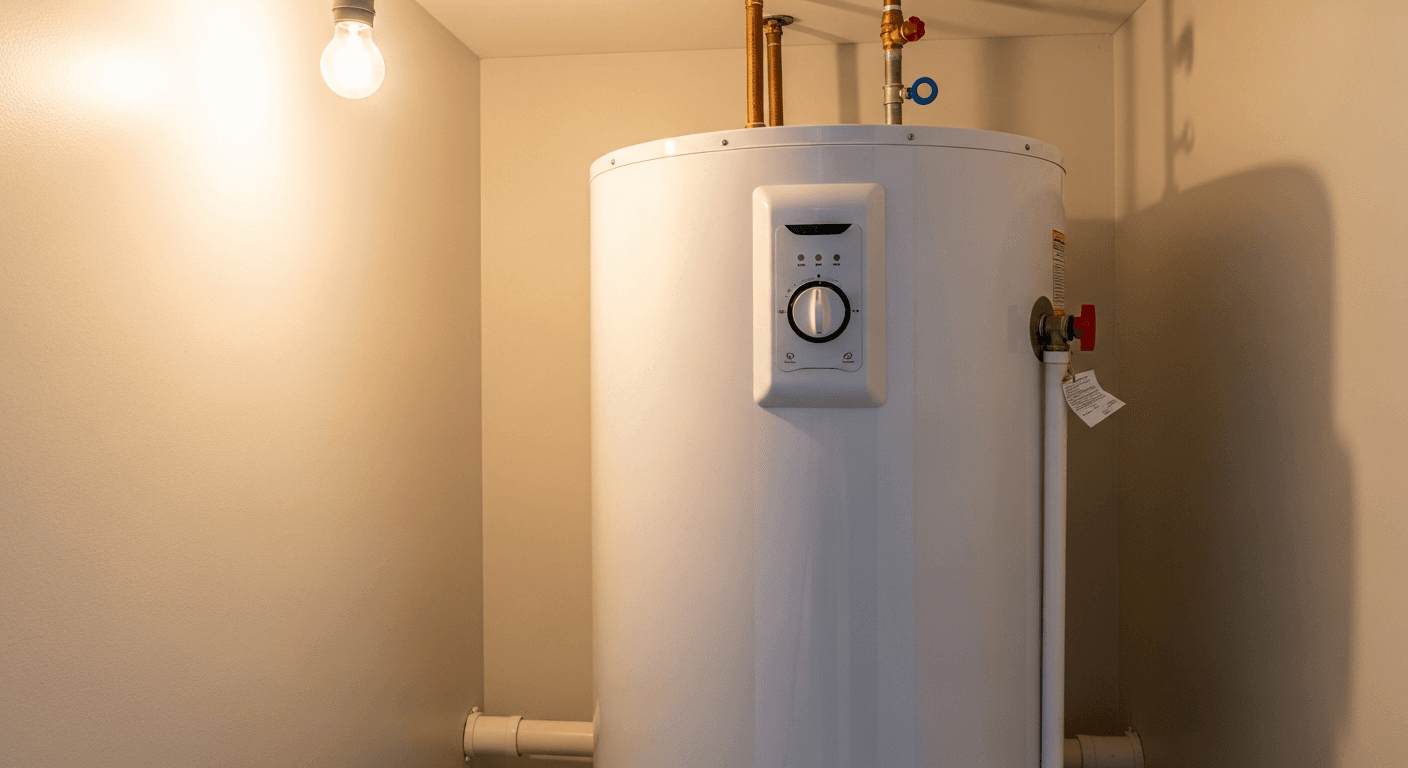
How to Know When It's Time to Replace Your Water Heater
Nobody thinks about their water heater until they're standing in a cold shower at 6 AM or wading through a flooded basement. It's the most ignored appliance in your house — quietly working in a closet or garage until it decides to ruin your week.
Here's how to know if yours is on borrowed time, what your replacement options are, and what you'll actually pay.
Water Heater Lifespan: How Long Should Yours Last?
Every water heater type has a different life expectancy:
- Conventional tank (gas or electric): 8–12 years
- Tankless (gas): 15–20 years
- Tankless (electric): 12–15 years
- Heat pump (hybrid) water heater: 12–15 years
- Solar water heater: 15–20 years (panels), 10 years (storage tank)
The single biggest factor in lifespan? Water quality. Hard water with high mineral content corrodes tanks and clogs heat exchangers faster. If you're on hard water and never flushed your tank, shave 2–3 years off those numbers.
Check the serial number on your water heater's label. Most manufacturers encode the date in the first four characters — typically the month and year of manufacture. If yours is 10+ years old, start planning now rather than reacting later.
7 Signs Your Water Heater Is Failing
1. Rusty or discolored hot water
If rust-colored water only comes from the hot side, your tank's interior lining is breaking down. The anode rod — a sacrificial metal rod that attracts corrosion so your tank doesn't — is probably gone. Once rust reaches the tank walls, replacement is the only fix.
2. Rumbling, banging, or popping sounds
Sediment buildup at the bottom of the tank hardens over time and creates a barrier between the burner and the water. The noises you hear are steam bubbles forcing through that sediment layer. It makes your heater work harder, drives up energy bills, and accelerates tank failure.
3. Water pooling around the base
Any leak from the tank itself (not from fittings or the T&P valve) means the tank has corroded through. This isn't repairable. If you see water under your heater, check connections first — but if it's the tank body, replace it before it becomes a flood.
4. Not enough hot water
If your 50-gallon tank used to handle two showers and a dishwasher load but now runs out after one shower, the heating element is likely failing (electric) or sediment has reduced the tank's effective capacity (gas). Sometimes a flush and element replacement fixes this. Sometimes it means the tank is done.
5. Inconsistent water temperature
Temperature swings — hot, then lukewarm, then hot again — usually mean a failing thermostat or heating element. On gas models, it could be a dirty or failing thermocouple. These are often repairable, but on an older unit, the repair cost may not be worth it.
6. Frequent repairs
If you've replaced the anode rod, a heating element, and the thermostat in the last two years, your water heater is telling you something. When repair costs start approaching 50% of a new unit's price, it's time to stop patching and start replacing.
7. Your energy bills are climbing
Water heating accounts for about 18–20% of your home's energy bill. An aging, sediment-filled heater works harder and uses more energy to produce the same amount of hot water. If your gas or electric bill has crept up without an obvious explanation, your water heater may be the culprit.
Tank vs. Tankless: Which Should You Get?
Conventional tank water heaters
Tank water heaters store 30–80 gallons of hot water and keep it ready around the clock. They're simple, reliable, and the most affordable to buy and install.
- Purchase price: $500–$1,800 for the unit
- Installation (straight swap): $800–$1,500
- Total installed cost: $1,300 – $3,300
- Annual operating cost: $400–$600 (gas), $500–$800 (electric)
- Best for: Budget-conscious homeowners, homes with predictable hot water demand
Popular models: Rheem Performance Plus 50-gallon ($700–$900), A.O. Smith Signature 100 ($650–$850), Bradford White 50-gallon ($800–$1,200 — plumber-exclusive brand).
Tankless water heaters
Tankless units heat water on demand as it flows through. No storage tank, no standby energy loss, and theoretically unlimited hot water. The catch? Higher upfront cost and potentially complex installation.
- Purchase price: $800–$2,500 for the unit
- Installation (new): $1,500–$4,500 (gas lines, venting, electrical may need upgrading)
- Total installed cost: $2,300 – $7,000
- Annual operating cost: $250–$400 (gas), $350–$550 (electric)
- Best for: Homes with space constraints, households that value efficiency, homes where 2+ showers run simultaneously
Popular models: Rinnai RU199iN ($1,800–$2,200, top-rated gas), Navien NPE-240A2 ($1,500–$2,000, excellent efficiency), Rheem RTEX-18 ($500–$700, best electric tankless).
The real-world payback: Going from a tank to gas tankless saves $100–$200/year in energy. At a $3,000–$4,000 premium in installation cost, that's a 15–30 year payback period. You're not buying tankless to save money — you're buying it for unlimited hot water, space savings, and a 20-year lifespan.
Heat pump water heaters
Heat pump water heaters (also called hybrid water heaters) are the efficiency kings. They work like a refrigerator in reverse — pulling heat from surrounding air and transferring it to water. They use 60–70% less electricity than conventional electric tanks.
- Purchase price: $1,200–$2,800 for the unit
- Installation: $1,000–$2,500
- Total installed cost: $2,200 – $5,300
- Annual operating cost: $150–$300
- Best for: Homes with electric water heating in warm or temperate climates, anyone wanting to lower energy bills significantly
Popular models: Rheem ProTerra 50-gallon ($1,500–$2,000, WiFi-enabled), A.O. Smith Voltex ($1,400–$1,800), GE GeoSpring ($1,200–$1,600).
Important caveat: Heat pump water heaters need space. They require 700–1,000 cubic feet of air around them (roughly a 10x10 room) and they cool and dehumidify the space they're in. Great in a warm garage or basement, not ideal for a small closet.
Note: the federal Energy Efficient Home Improvement Credit (25C) that previously covered up to $2,000 for qualifying heat pump water heaters expired at the end of 2025. Factor the full installed cost into your payback calculation — though many utilities still offer $200–$800 rebates that help close the gap.
Replacement Costs at a Glance
- Tank (gas), straight swap: $1,300 – $2,800
- Tank (electric), straight swap: $1,200 – $2,500
- Tankless (gas), new install: $3,000 – $7,000
- Tankless (electric): $1,500 – $3,500
- Heat pump (hybrid): $2,200 – $5,300
A straight swap — same fuel type, same location, no code upgrades needed — is the cheapest path. Switching fuel types or adding a tankless where one didn't exist adds $1,000–$3,000 in extra work.
How to Extend Your Water Heater's Life
A little maintenance goes a long way:
- Flush the tank annually. Drain 3–5 gallons from the bottom valve to remove sediment. Takes 15 minutes, saves years of life.
- Replace the anode rod every 3–5 years. It's a $30–$50 part and 30 minutes of work. This one maintenance item can add 3–5 years to your tank's life.
- Check the T&P (temperature and pressure) relief valve annually. Lift the lever, let it snap back. If it drips afterward or doesn't release water when lifted, replace it ($20–$30 part).
- Insulate the tank. A $25 water heater blanket from Home Depot reduces standby heat loss by 25–45%, especially on older units in unheated spaces.
- Set the temperature to 120°F. Factory default is often 140°F, which wastes energy and increases scalding risk.
For tankless units, descale with vinegar annually (or every 6 months in hard water areas). Most units have service valves that make this a DIY-friendly job with a $100–$150 flush kit.
When to Repair vs. Replace
Here's the decision framework:
- Replace if: The tank is leaking, the unit is 10+ years old and needs a major repair ($500+), or you're replacing parts for the third time in two years.
- Repair if: The unit is under 8 years old, the issue is a thermostat, element, or anode rod, and the repair costs less than 50% of a new unit.
Common repairs and costs:
- Thermostat replacement: $150–$300
- Heating element (electric): $150–$300
- Anode rod replacement: $150–$250 (pro) or $30–$50 DIY
- T&P valve replacement: $100–$200
- Gas control valve / thermocouple: $200–$400
If you're not sure whether to repair or replace, Electrum Home's quote tool can get you pricing for both options from local pros so you can compare side by side.
Frequently Asked Questions
How do I know how old my water heater is?
Check the serial number on the manufacturer's label (usually on the side of the tank). Most brands encode the manufacture date in the first few characters. For example, Rheem uses a format like "0718" meaning July 2018. If you can't decode it, search "[brand name] serial number date decoder" — most manufacturers have guides.
Can I install a water heater myself?
Electric tank water heaters are the most DIY-friendly — it's basically connecting water lines and wiring. Gas water heaters involve gas line connections and venting, which most building codes require a licensed plumber or HVAC tech to handle. Tankless installations almost always need a pro due to gas line sizing, venting, and electrical requirements. Permits are required in most jurisdictions regardless of who does the work.
Is tankless really worth the extra cost?
If you're replacing an existing tank with another tank, probably not — the energy savings don't justify the 2–3x higher installation cost. If you're building new, remodeling, or your household genuinely runs out of hot water regularly, tankless makes sense. The 20-year lifespan and endless hot water are the real selling points, not the energy savings.
What size water heater do I need?
For tank heaters: 1–2 people need 30–40 gallons, 2–3 people need 40–50 gallons, 3–4 people need 50–60 gallons, and 5+ people need 60–80 gallons. For tankless, it's measured in GPM (gallons per minute) — a single shower uses 2 GPM, so a household running two showers plus a dishwasher simultaneously needs 6+ GPM. Most whole-house gas tankless units deliver 8–10 GPM.
Are there rebates available for water heater replacement?
Yes, though the landscape has changed. The federal 25C Energy Efficient Home Improvement Credit that offered up to $2,000 for heat pump water heaters expired at the end of 2025. The good news: many utilities still offer $200–$800 rebates for heat pump models, and ENERGY STAR-certified gas tankless units often qualify for utility rebates too. Check DSIRE (dsireusa.org) and your local utility's website for current offers — state and utility programs are now where the meaningful savings live.
Ready to move forward?
See what your project actually costs.
Real itemized price in minutes — specific to your house and zip code. No account, no sales call.
See what it costs →